Chat with us
Join our waitlist

The Math of Leverage: LAP vs. Top-Up vs. Personal Loans

02 MAR,2026     5 min read

The Math of Leverage: LAP vs. Top-Up vs. Personal Loans

You now know your equity isn't dormant; it's waiting (Blog 37) . But banks seldom promote Home Equity products. Instead, they push pre-approved Personal Loans. Why is that? Because the math favors the bank with personal loans and favors you with a home equity loan. Let’s break down the numbers.

1. The Interest Rate Arbitrage

When you borrow money, the interest rate shows how risky it is for the bank.

    • Personal Loan (Unsecured) : 3-5 years and 12% to 16% p.a. (High risk for the bank).
    • Loan Against Property (LAP) : 10-15 years and 9.5% to 11.5% p.a.
    • Top-Up Home Loan : 8.5% to 10.5% p.a.
    • The Reality : For many homeowners, a Top-Up loan is one of the cheapest ways to access funds. Taking a high-interest personal loan while having ₹1 Crore in home equity is financial self-sabotage.

2. Loan-to-Value (LTV) Constraints

Don't expect the bank to give you 100% of your equity
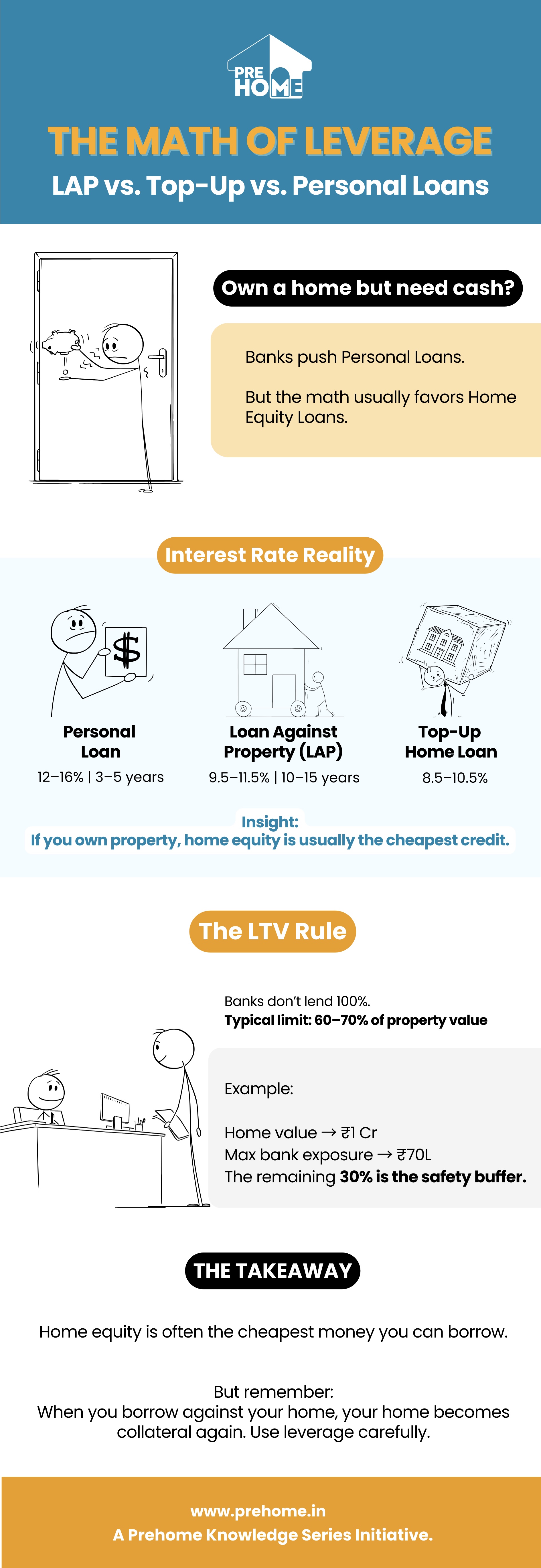
    • The Cap : RBI rules and bank risk assessments usually limit LAP and Top-Up loans to 60% to 70% of the home's current market value.
    • The Buffer : If your property is worth ₹1 Crore, the bank's maximum total exposure (existing loan plus new loan) is ₹70 Lakhs. This 30% buffer protects both you and the bank from sudden market drops.

3. Behavioral Economics: The "Mental Accounting" Trap

This is where smart people lose their homes. Behavioral psychology warns us about Mental Accounting—the habit of treating different money sources with unequal value. Homeowners often see equity as "lottery money" or a bonus, instead of as hard-earned wealth.

    • Bad Leverage : Extracting equity at 9% to "play" in the stock market, buy cryptocurrencies, or purchase an expensive car. This increases your risk.
    • Good Leverage : Extracting equity to support a business, renovate your property, or consolidate high-interest debt.

The math shows home equity is the cheapest money you can borrow. But cheap money is also the easiest to waste. When you borrow against your home, the asset becomes collateral again. If you fail to repay, the bank's claim takes precedence over your emotional ties. This is why leverage should always serve productive or stabilizing purposes.

In Our Next Series :

We’ve examined interest rates and psychological traps. Now, let’s see how the top 1% actually use this strategy in the real world. Blog 39 Smart Moves: How to Use Home Equity to Build Wealth